The uncomfortable peace between the freedom of speech and expression, artistic liberties and copyright laws has again been disturbed. This time the challenge is mounted by Nina Paley, a
The theme of the movie, as briefly defined on the movie’s website is:
Sita is a goddess separated from her beloved Lord and husband Rama. Nina is an animator whose husband moves to India, then dumps her by email. Three hilarious shadow puppets narrate both ancient tragedy and modern comedy in this beautifully animated interpretation of the Indian epic Ramayana. Set to the 1920's jazz vocals of Annette Hanshaw, Sita Sings the Blues earns its tagline as "The Greatest Break-Up Story Ever Told”.
The animated film has won awards and rave reviews in several film festivals around the globe. An article by film critic Roger Ebert is an example of the praise the film has garnered.
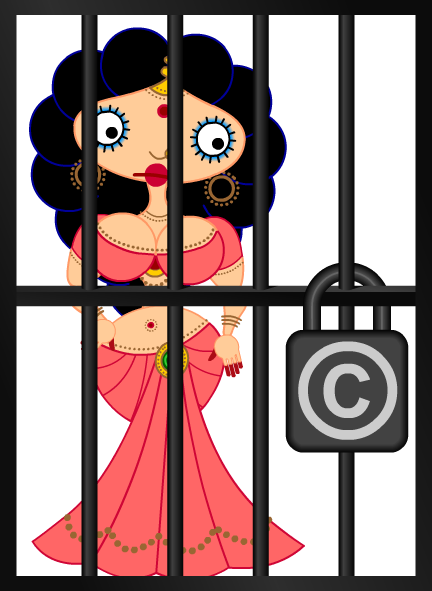
In spite of the praise and hype, Paley is unable to release the film commercially because it’s locked in the ‘copyright jail’. In fact Nina’s blog has quite an image of a blue eyed, curvaceous, made up Sita behind bars which seek to symbolise the copyright jail. The image is reproduced above.
The problem relates to the music used by Paley. The music consists of 11 Hanshaw recordings. The copyright over these sound recordings has run out and they are in the public domain. However, in lieu of the term extension granted to copyrighted works by the Sony Bono Copyright Term Extension Act, the underlying compositions, i.e., the lyrics and written music for the songs are still protected as musical works under copyright law. Thus, in order to release the movie, Paley needs to get licenses from the owners of these underlying works. The owners of the 11 tracks used in the movie are the ‘big boys’ in business, namely, EMI, Sony-ATV Music Publishing and Warner-Chappell Music amongst others.
Originally, these corporations are ready to give the license for the 11 songs at issue in the movie was $220,000. This sum was simply unaffordable for Nina. Subsequently, Nina was able to get this amount reduced to a step-deal that starts at $50,000 (which she’s taking out a loan to pay) and goes up from there depending on how successful the film is.
The problem for Nina is that this step deal is also quite expensive and burdens her considerably. The working of the step deal is as follows: If the film was to be shown in theaters and made a million dollars at the box office, Nina would have to pay another $38,500 for the licenses. That means that if the film makes a million dollars at the box office, the publishing companies that own the rights to the compositions sung by Annette and used by Nina make more collectively than Nina makes. However, Nina is hopeful on this front as she says that after theaters, distributors, agents, etc. take their cuts and deduct their costs, $1million in theatrical receipts would trickle down to about $30,000 to $80,000 for her. Thus, it’s very unlikely to ever generate that much box office revenue, so as to trigger the additional payment costs.
As regards the DVD sale, the deal stipulates that for every 5,000 home video units sold (DVD or download sales or on-demand sales) Nina must pay another $750 per song, meaning $8,250. To this she adds her own middleman fees (lawyer or negotiator – for which she has already been billed about $10,000 just trying to negotiate with these corporations). This is based on the calculation such that the fee of the corporations works out to be $1.65 per DVD, regardless of how much the DVDs sell for. This concerns Nina as it can turn out to be a costly proposition in a situation where she is already debt ridden.
Unable to pay the basic amounts, Nina’s movie isn’t finding any distributors. Hence, in order to find a way outside this maze, Nina has turned to her audience, vehemently arguing that copyright laws are being used by these corporations to own culture and independent film making is very difficult with these sharks in the water. Hence, the audience is asked to make donations to the cause to free the movie of this prison and help in its distribution. Just to note that normally such charges of licenses etc are paid by the distributors of the film. However, given the financial crises, the distributors are bleeding and aren’t giving any support to the independent indie film.
So it’s a big bad world and red riding hood needs to be rescued. Nina says that she will release her film under the Creative Commons Share-Alike, or some equivalent of the GNU/Linux license. Such a move will prevent it and any derivative works from ever being copyrighted by anyone. The free online copies of the movie will be marketed as promotional copies and such copies will fall outside the ambit of the step deal. As per the terms of the step deal, such copies can be distributed without the copyright owners laying a claim to the same. So Nina also plans to distribute promotional copies such that more people can get their hands on the movie.
Interestingly, in a scathing critique of the entire situation, Ben Sheffner states that Paley should have dealt with the problem of licenses prior to the making of the film. If the music was such an integral part of the film, then rights related to it should have been cleared at the earliest. Moreover, the bigger issue is whether you should be allowed to use someone else’s work in your creation even when you cannot afford it. Nina argues that she has worked on ideas already there and that charging such high prices suppresses art. Sheffner goes on to state that such a right to use another’s property at a price you afford simply doesn't exist in the law. He compares the situation to arguing that one has a right to the new BMW 6-Series at a price at which he can afford it, rather than the price BMW chooses to charge. In a response, Goldenrail argues that it is not fair to compare these licenses to a BMW, as once BMW sells the car, it cannot sell the same car again. However, for the publishing companies to come to a reasonable agreement with Nina (she offered them a %), it would increase the value of their property by getting it more attention, not remove the property from their possession all together, as with a physical good. So they keep earning from it. Further, he argues that promoting the movie under the GNU/Linux license does not take away from the illegality of the use of Hanshaw’s music. He concludes to state that, “But Paley, like everyone else, must obey the law, and pay for using what isn’t hers. That, she does not seem to have done.”
Which way this debate goes is for us to wait and watch….
@Suchita Saigal
ReplyDelete"The uncomfortable peace"? I'm glad at least someone is able to be optimistic and see "peace" in the equation between freedom of speech and copyrights.
"Nina says that she will release her film under the Creative Commons Share-Alike, or some equivalent of the GNU/Linux license. Such a move will prevent it and any derivative works from ever being copyrighted by anyone."
1. The first licence you link to is CC Attribution/Share-Alike licence.
2. There is no such thing as a GNU/Linux licence. There is the GNU GPL (under v2 of which the Linux kernel is licensed), and the GNU FDL (to which you have linked). GNU/Linux is the name (used by Stallman and other "free software" people) to refer to the combination of the GNU OS and the Linux kernel. It is not a licence.
3. Even if it is licensed under the GFDL or CC-BY-SA, how would that "prevent it and any derivative works from ever being copyrighted by anyone"?? The copyright in all works created by Nina Paley vest in her. She is LICENSING it out under the GFDL, CC-BY-SA, etc. She is not relinquishing her copyright. Derivative works will be similarly copyrighted, but must also be licensed under similar terms (since both GFDL and CC-BY-SA are "copyleft" licences).
How a blog on IP could make such fundamental mistakes is beyond me.
More later.
- Anon. Coward
Sheffner's comments only make sense if one thinks of these monopolies as "property", a point of view which is rejected by the law, interestingly, which has consistently recognized that a statutory monopoly is not the same as property. It is a privilege granted by the legislature, and it can be extended or retracted without compensation to harmed parties (note that when Congress changes copyright laws in a way that weakens the monopoly for some parties, no compensation is paid; compare that with what would happen in an eminent domain seizure of real property).
ReplyDeleteSo the argument that these songs are the rightholder's "property" is pretty bogus, from a legal point of view. Those companies purchased a privilege, and did so with no guarantee that the legislature would maintain that privilege.
It's also bogus from a logical point of view. Clearly, songs are not like real property: steal my shirt, and now I have no shirt; sing my song, and now we both have it (and so do both of our audiences). Furthermore, this monopoly right is rather recent. Copyright did not exist before 1710, yet there was no shortage of music or literature or culture in general before that. Which is to be expected, since the copyright laws were not created to promote creation, but rather to regulate and subsidize the nascent printing industry (something that Sheffner and the songs-are-like-property crowd always seem to forget.)
Nina argues that granting this monopoly privilege to some causes too much harm to others: namely, those others who are trying to share culture and make derivative works. Both logically and simply from an aesthetic standpoint, she's on solid ground: when we see terrific films like "Sita Sings The Blues" getting censored, something is clearly wrong in how we're approaching copyable and derivable works.
Sheffner's "she must obey the law" theme misses the point. Nina's saying that the law is wrong. She's not arguing about whether something is legal, she's arguing that it should be legal. Conscious, civil-disobedience-style demonstrations may be necessary to get the point across, but the point remains the same: the law is bad, let's change it.
Sheffner doesn't have to agree with that, but if he wants to respond to what Nina is actually saying, that's the question to engage, rather than (apparently) assuming that the law is infallible because it's the law.
Apologies -- I should have specified that my post was U.S.-law-centric. India's IP law may be different; however, Sheffner was commenting about U.S. law anyway.
ReplyDeleteAlso, if we can step away from the legal thicket for a second: as a musician I just find it personally repugnant that someone can "own" a song. One can be the author of a song -- that is, one can (and should) receive credit for creative work -- but that's about attribution. Actual ownership doesn't make sense for culture. Ownership of culture inevitably results in censorship, and that's exactly what's happenening here.
Anon. Coward - I think you're being a little too hard on the piece's author. Creative Commons is relatively new, and though it has spread to more countries, it is still primarily a US-thing. It's good of you to point out how CC works (that it's licenses for copyright owners to use in their copyrighted works), but you don't have to be angry about it.
ReplyDeleteYou are right in the details of the Creative Commons licenses, but those details are sort of beside the point. Nina's work, even under a cc-by-sa license, is still copyrighted and derivative works will still be copyrightable; however, people will be able to use her work to make derivative works without worrying about going through the same troubles she's going through (as long as they don't use parts with the Hanshaw recordings). She's not saying (and I think there are few who would say) copyright is bad; she's saying it is being used in a bad way and if using it in this bad way is "the law" then the law needs some adjusting. Karl's got some good points; I hope you read his comment.
Suchita, thanks for picking up the story.
After reading "Clearance and Copyright " by Michael C. Donaldson,one of the most thorough books out there that discusses copyright laws, I am amazed at how many copyright laws there really are out there!
ReplyDelete@Suchita & goldenrail
ReplyDeleteI agree that I was unduly cantankerous in my last comment. I wasn't in all that good a mood that day. I'm sorry for that. I agree with you that all my ranting about the CC licences was besides the point. It's just that these are common misconceptions (that one is used to seeing in newspapers) about free software and open content licences, and it got my goat that day to see it being perpetuated in an IP blog. Though, that is not an excuse, and I could (and should) have been less rude in pointing it out.
I'm completely in agreement with Karl. I wouldn't go as far as to call Sheffner's write-up a "scathing critique" though, since all that it really says is: She knew what the law was. That completely misses the point, as Karl's indicated, that the law needs to change. If the copyright system is truly one of 'incentivisation' as the U.S. system (and the American Constitution) declares it to be, then retrospective copyright term extensions make no sense whatsoever.
Also, I'm not sure if Paley is not saying that copyright is bad. After all, she's advocating the return of the patronage system as the model for funding of the arts instead of exclusive rights over artistic creations.
Plus, I thought I'd post this link to a new story in Wired's Underwire blog: Sita Director Sells Herself Over Copyright Blues.
Thank you all for your comments:
ReplyDelete@Anon.
For starters, the link is provided to a page contains a description of the share alike license.
Also, the entire line about licenses etc is directly taken from Nina's blog and her take on Sita's distribution plan.. to quote:
"I will license it either as Creative Commons Share-Alike, or some equivalent of the GNU/Linux license. This will prevent it and any derivative works from ever being copyrighted by anyone." check the following link: http://blog.ninapaley.com/2008/12/28/sitas-distribution-plan/
I apologize for confusion caused, the point of inserting that line was to put on board Nina's plan in her words and her understanding. Thanks for clarifying the point.
Regards,
A not so cranky Suchita
Assuming that EMI etc. do have valid copyrights on the music that is used in the movie, I would believe that making an unlimited number of copies available as "promotional copies" would infringe those copyrights. Even if Nina's copyrights in the movie are licensed under some open license - which in itself is something Nina may do - then still she cannot sublicense the copyrights of EMI etc. under that open license, so that everybody who wants to distribute the movie on the basis of that open license still has to obtain the permission of EMI etc.
ReplyDelete@ Anonymous - the whole idea of her being able to give away promotional copies w/o infringing the copyrights has nothing to do with whatever CC license she might put on her work. (You're right, that would still be infringement.) It comes from the step-deal she made with the copyright owners, which allows her to not count promotional copies in the #s that are used to calculate how much she needs to pay for licensing the works.
ReplyDeletegoldenrail wrote: "She's not saying (and I think there are few who would say) copyright is bad..."
ReplyDeleteShe actually is saying that it's bad. So am I.
The industry tries very hard to paint a picture of copyright as the friend and shield of the little, beleaguered artist. The printers took that same tactic when they invented copyright, three hundred years ago, as a monopoly to replace an expiring censorship law that had previously granted them monopoly rights on printing. It is true that some artists earn money from copyright, just as it is true that some people win the lottery, but that doesn't make lotteries a good system overall. Most artists don't earn their livings from copyright -- nor is this surprising, considering that it wasn't designed to enable them to do so, but rather to enable the business model of centralized distribution.
Remember, it's not about attribution either: everyone here agrees that artists should get credit for their work. But that's not what copyright does. Copyright is a restriction on sharing even accurately attributed works.
I think there's little point saying we just need to put "balance" back into the system. Once you propertize something, there is only one path it can take: property inevitably concentrates, because posession of it gives the possessors the resources to lobby for yet more restrictive laws. That is exactly what has happened in the case of copyright term extensions, for example.
It is particularly destructive to make limited property out of that which is by nature unlimited. When copyright was invented, it made at least some sense: printing really is a tough business, and to get printers to behave well (toward authors and toward each other), some sort of temporary monopoly wasn't such a bad solution.
But in the age of the Internet? It's just silly now. It would be like a law charging people for how much oxygen they use. Yes, oxygen is valuable, and yes, people use it in different amounts and for different purposes... But the physics of the situation just are not set up to charge for it by the unit. There's no point trying. The physics of culture are like that now, and there is no going back.
What the so-called rights-holders (I prefer to call them "rights-restricters") are doing to Nina Paley is censorship. When you're an artist, culture is your oxygen, but they are still trying to sell it by the cubic centimeter.
Copyright does not "protect" artists. It restricts them. It protects a monopoly-based business model, which is precisely what it was designed to do.